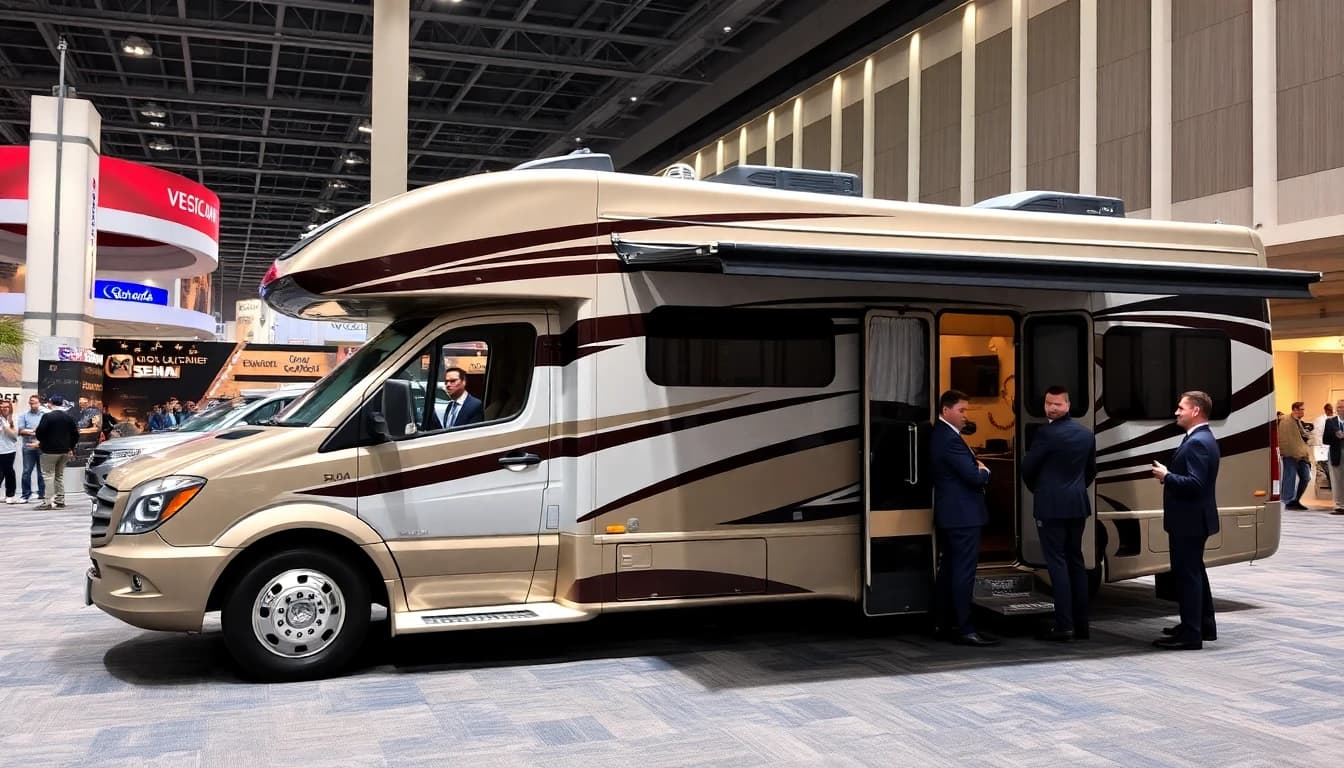
Planning a show-floor or lot activation?
Tell us whether the unit is going inside a hall or into a lot. Those are different rule sets and different bookings, and we will spec to whichever one you are actually in.
Clark County Fire Code 314.4, for a vehicle displayed indoors
- Fuel: "Fuel in fuel tanks does not exceed one-quarter tank or 5 gallons (19 L) (whichever is least)."
- Batteries: "Batteries are disconnected, or the engine starting system is made inoperable, except where the fire code official requires that the batteries remain connected to maintain safety features."
- Fueling: "Vehicles, aircraft, boats or motorcraft equipment are not fueled or defueled within the building."
- Not specified in 314.4: aisle widths, clearances from exits, or a display permit. Those come from the venue and the show, not this section.
Five gallons, not a quarter tank
The wording that matters is "whichever is least." For a passenger car with a 16-gallon tank, a quarter tank is four gallons and that is the binding number. For a motorhome, the quarter-tank figure is never relevant. A coach carrying a 90-gallon tank would be allowed 22 gallons on the quarter-tank test, so the five-gallon figure governs instead.
Five gallons in a large diesel coach is a very short distance. At the sort of consumption a forty-foot unit returns, that is tens of miles rather than hundreds, and it is the entire fuel budget for getting the vehicle off the floor and to wherever it goes next.
What it costs to arrive full
The same section states that vehicles "are not fueled or defueled within the building," so you cannot solve this at the door by draining the tank on arrival. A coach that turns up full is a coach that cannot legally take its position, and the fix has to happen somewhere else, on your schedule, during move-in. Plan the fuel state as a load-in task with a location attached, not as something the driver handles.
The battery rule takes away your power source
Section 314.4 requires that batteries are disconnected or the engine starting system is made inoperable. There is an exception where the fire code official requires batteries to remain connected to maintain safety features, which is a decision for that official rather than for you.
The practical consequence is that the vehicle cannot be treated as its own power plant while it is on display. Lighting, screens, climate control and anything else you want running has to come from venue-supplied electrical service, ordered through the show's process on the show's deadlines.
The order deadline you did not know you had
A hospitality unit specified around its own generator and batteries has no power on the floor. Electrical service is a show order with an advance-rate deadline, and missing it means paying floor rates or going without. Add it to the plan at the same moment you book the unit, not after the stand design is signed off.
Indoors and outdoors are two different jobs
This is the distinction that decides everything else, and it is usually left implicit. A unit inside an exhibit hall is a fire code matter. A unit outside in a lot is a venue parking and credentialing matter, governed by the sort of oversized vehicle policy that decides where the unit may sit, what pass it needs, and whether it may stay overnight.
| Inside an exhibit hall | Outside in a lot | |
|---|---|---|
| Governed by | Fire code, indoor display rules | Venue oversized vehicle policy and show credentialing |
| Fuel | Quarter tank or 5 gallons, whichever is least | Not restricted by the indoor display rule |
| Batteries | Disconnected or starting system inoperable | Not restricted by the indoor display rule |
| Power source | Venue electrical service, ordered in advance | Onboard generator or a shore connection, venue permitting |
| Overnight | Set by the hall and the show schedule | Set by the venue. Many venues prohibit it outright |
| The main risk | A unit that cannot legally be positioned | A unit refused entry or towed for want of a credential |
Most trade show RV hospitality is in fact the outdoor version, which is why the fire code rules above come as a surprise to the minority who end up inside. If your brief is "a coach on the stand," you are in the left column and the fuel state is now a project task.
What CES actually publishes, and what it does not
We looked for a public, quotable CES rule on vehicles and outdoor exhibits and did not find one. CES publishes exhibitor manuals per venue through its Exhibitor Guides, and points operational questions at CES Operations and at an assigned Convention Services Manager. The specifics for vehicle display and outdoor exhibit space are not on the open pages.
So we are not going to reproduce a CES vehicle rule, because we cannot source one. Treat the manual for your specific hall as the authority, and treat every third-party summary of CES rules, this page included, as a prompt to go and check rather than as the answer.
Why this matters more than it sounds
Show rules are venue-specific and they change year to year. A plan built on last year's manual, or on a competitor's blog post summarising it, is a plan built on a document that has since been reissued. Get the current manual for your hall and read the vehicle section yourself before you commit to a unit.
Nobody publishes a price, so we will not print one
An earlier version of this page carried a set of confident cost ranges for trade show RV hospitality. Neither CES nor the venues publish rates for this, and the components vary so widely by hall and by show that a single all-in figure is not meaningful.
What can be priced firmly in advance is the unit itself. What cannot, until you have the show's order forms, is exhibit space, electrical service, rigging and material handling. Build the budget as one fixed number and a set of show-order lines, and confirm each as the forms open.
What most people get wrong: material handling and who may touch the unit
Large shows operate through appointed contractors, and CES publishes rules for Exhibitor Appointed Contractors covering who may work on a stand and under what conditions. That is worth reading before you assume your own team, or the rental company's driver, may position and connect a unit on the floor.
The question to ask your Convention Services Manager is not "can we bring a coach" but "who is permitted to move it, connect it and work on it once it is in the hall." The answer determines your labour cost and your load-in schedule, and it is the part of the plan most often discovered late.
"The convention work is the one where I ask the most questions before quoting, because the same coach is a completely different proposition inside a hall and in a lot two hundred yards away. Inside, I am delivering a vehicle with five gallons in it and a disconnected battery, and everything it does on the floor runs off the venue. Outside, it is a normal hospitality unit with a credentialing problem. Clients ask for the same thing in both cases and they are not the same thing."
— Ben Kiser, Co-Founder, EventFleetRV
Plan it in this order
- Establish indoors or outdoors. Everything below branches on that answer.
- If indoors, get the current exhibitor manual for your specific hall and read the vehicle section.
- Plan the fuel state as a load-in task with a location, since defueling in the building is prohibited.
- Assume the chassis battery is disconnected and specify venue electrical service for everything the unit needs to do.
- Order that electrical service by the advance-rate deadline.
- Confirm who is permitted to move, position and connect the unit on the floor.
- If outdoors, confirm the venue's oversized vehicle pass and whether overnight presence is allowed at all.
- Budget the unit as a firm number and the show orders as open lines.
Frequently Asked Questions
How much fuel can an RV have inside a Las Vegas convention hall?
Very little. Clark County Fire Code section 314.4, covering indoor displays, requires that "Fuel in fuel tanks does not exceed one-quarter tank or 5 gallons (19 L) (whichever is least)." For a motorhome with a large tank the quarter-tank figure is irrelevant, because five gallons is always the lesser number. The same section states that vehicles "are not fueled or defueled within the building," so the tank has to be brought down to compliance before the unit enters.
Does an RV battery have to be disconnected on a trade show floor?
Under Clark County Fire Code 314.4, "Batteries are disconnected, or the engine starting system is made inoperable, except where the fire code official requires that the batteries remain connected to maintain safety features." So the chassis cannot be started while on display. Anything you want running in the unit should be planned on venue-supplied electrical service rather than on the vehicle’s own systems, and the exact treatment of house batteries is a question for the fire code official rather than something to assume.
Is trade show RV hospitality usually indoors or outdoors?
They are two different jobs. A unit inside an exhibit hall is a fire code matter governed by indoor display rules on fuel, batteries and fueling. A unit outside is a venue parking and credentialing matter, governed by the venue’s oversized vehicle policy. Establish which one you are doing before anything else, because almost none of the constraints carry across.
Where are the CES rules for vehicles and outdoor exhibits published?
Not publicly in full. CES publishes exhibitor manuals per venue through its Exhibitor Guides, and directs operational questions to CES Operations at CESops@CTA.tech or to an assigned Convention Services Manager. Vehicle display and outdoor exhibit specifics are not published on the open pages we checked, so confirm them through the manual for your specific hall rather than relying on any third-party summary, including this one.
What does trade show RV hospitality cost?
Neither CES nor the venues publish a rate for this. The costs that exist are the unit rental, which is quotable in advance, plus show-specific charges such as exhibit space, electrical service and material handling that come from the show’s own order forms. Treat any single all-in figure quoted elsewhere as an estimate rather than a published price.
Sources
- Clark County Fire Code 2018, Chapter 3 — General Requirements, section 314.4 — the indoor display fuel limit, the battery disconnection requirement and the prohibition on fueling or defueling within the building. Checked September 7, 2026.
- CES — Exhibitor Manuals — that manuals are issued per venue and that operational questions route to CES Operations. Vehicle and outdoor exhibit specifics were not published on the open pages when checked, September 7, 2026.
- CES — Exhibit Space — that CES offers both indoor and outdoor exhibit space. Checked September 7, 2026.
Related Guides
Ben co-founded EventFleetRV and oversees all fleet operations and logistics. With extensive experience coordinating RV deployments for NASCAR events, major festivals, and corporate productions, he ensures every fleet delivery exceeds client expectations.
Show Floor or Lot, Specced Correctly
We work to the hall's rules and the venue's, and we tell you which of the two you are actually in. One request, one contact, one invoice.