Not sure how many units you need?
Tell us your event, dates, and headcount — a coordinator helps you right-size the fleet, then sources, delivers, and sends one invoice. A coordinator replies, usually same day.
Quick Answer: Fleet Size Calculator
Basic Formula:
(Total Guests ÷ 5) × 1.15 = Recommended RV Count
Using 5-person comfortable capacity per RV with 15% buffer
Small Event (20-40 guests)
5-10 RVs
Medium Event (50-100 guests)
12-25 RVs
Large Event (100+ guests)
25-50+ RVs
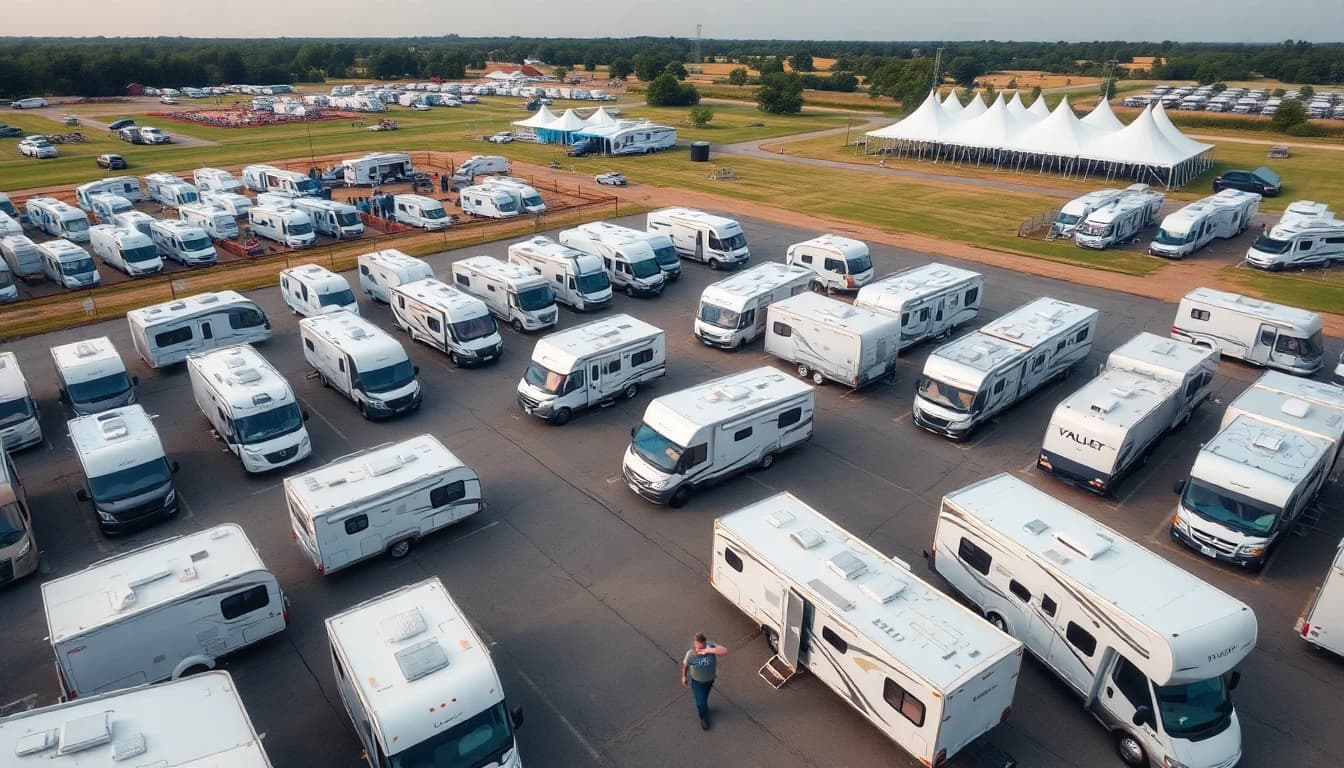
Fleet sizing determines event success. Insufficient units create overcrowding and guest dissatisfaction. Excess units waste budget and consume venue space. This guide provides formulas, event-specific calculations, and actual deployment data to calculate optimal fleet sizes. For RV type selection and fleet rental costs, see our companion guides.
Fleet Sizing Formulas
Standard Fleet Size Calculation
Step 1: Determine sleeping guests
Count guests requiring overnight accommodations (exclude day-only attendees)
Step 2: Calculate base units
Sleeping Guests ÷ Comfortable Capacity per RV = Base Units
Use 5 for Class C, 6 for Class A, 2 for Class B
Step 3: Apply buffer factor
Base Units × Buffer Factor = Final Count
Standard events: 1.10-1.15 (10-15% buffer) | High-profile events: 1.20-1.25 (20-25% buffer)
Step 4: Add functional units
+ Hospitality units, mobile offices, production support as needed
Capacity by RV Type
| RV Type | Max Capacity | Comfortable Capacity | VIP Capacity | Use for Calculation |
|---|---|---|---|---|
| Class A Motorhome | 6-8 | 4-6 | 2-4 | 5-6 |
| Class C Motorhome | 6-8 | 4-5 | 2-3 | 4-5 |
| Class B Van | 2 | 2 | 1-2 | 2 |
| Travel Trailer | 4-10 | 3-6 | N/A | 4 |
| Star Wagon | 1-2 | 1 | 1 | 1 |
Fleet Sizing by Event Type
Corporate Events & Retreats
Corporate deployments balance guest comfort with professional functionality. Higher comfort ratios than festival events.
| Event Size | Guest Count | Accommodation Units | Functional Units | Total Fleet |
|---|---|---|---|---|
| Executive | 10-20 | 3-5 | 1-2 | 4-7 |
| Small | 20-40 | 5-10 | 2-3 | 7-13 |
| Medium | 40-100 | 10-25 | 3-5 | 13-30 |
| Large | 100-250 | 25-60 | 5-10 | 30-70 |
Corporate events use 4-person comfortable capacity for Class C units. See our trade show RV rental guide for convention-specific sizing.
Music Festivals & Events
Festival fleets serve multiple stakeholder groups: artists, production crew, VIP guests, and sponsors. See our festival RV rental guide for detailed planning.
Festival Fleet Components
Artist Accommodations
- Headliners: 1 Class A per artist
- Supporting acts: 1 Class C per 2-3 artists
- Band members: 1 Class C per 4-5 musicians
Production & Crew
- Production staff: 1 RV per 5-6 crew
- Production offices: 2-4 mobile offices
- Medical/Security: 2-4 dedicated units
Festival Fleet Sizing Example
3-day festival, 25 performing artists, 60 production crew, 40 VIP guests:
- Artist units: 4 Class A (headliners) + 8 Class C (supporting acts) = 12 units
- Production crew: 60 ÷ 5 = 12 units
- VIP guests: 40 ÷ 4 = 10 units
- Functional: 2 medical + 2 production offices = 4 units
- Total recommended: 38 RVs
NASCAR, F1 & Racing Events
Motorsports deployments focus on infield hospitality with space-constrained venue requirements. See our Daytona 500 RV rental guide and tailgating guide.
Infield Camping
- Group size: 20-30 guests
- Recommended: 5-8 RVs
- Space: 50×40 ft per unit
Corporate Hospitality
- Guest count: 40-80
- Recommended: 10-20 RVs
- Premium: 2-4 Class A units
Team Support
- Crew size: 15-25
- Recommended: 4-6 RVs
- + 1-2 mobile offices
Film & TV Production Basecamps
Production fleet sizing follows SAG-AFTRA requirements for talent accommodations. See our basecamp setup guide, talent trailer guide, and honeywagon guide.
Production Fleet Standards
| Role | Unit Type | Allocation |
|---|---|---|
| Lead actors | Star Wagon | 1 per lead |
| Supporting cast | Class C / Double-banger | 1 per 2-3 actors |
| Hair/Makeup/Wardrobe | Honeywagon | 1-2 units |
| Director/Producer | Mobile Office | 2-3 units |
| Crew facilities | Various | Based on crew size |
Real Fleet Deployment Examples
Actual fleet configurations from EventFleetRV deployments. These examples demonstrate how formulas translate to real-world sizing decisions.
Tech Company Product Launch: Las Vegas
Event Parameters
- Duration: 4 days (setup through teardown)
- Sleeping guests: 45 executives
- Day attendees: 120 additional
- Venue: Convention center adjacent lot
Fleet Configuration
- 4x Class A (C-suite, 2 guests each)
- 8x Class C (executives, 4-5 guests each)
- 2x Mobile Offices (meeting space)
- 1x Hospitality trailer (catering staging)
- Total: 15 units
Calculation check: 45 guests ÷ 4 (comfort capacity) = 11.25 × 1.15 buffer = 13 accommodation units + 2 functional = 15 total
Bonnaroo Artist Compound: Manchester, TN
Event Parameters
- Duration: 5 days
- Headliner artists: 4
- Supporting acts: 18
- Production crew: 45
- VIP guests: 30
Fleet Configuration
- 4x Class A (headliners)
- 9x Class C (supporting acts, 2 per unit)
- 9x Class C (production crew, 5 per unit)
- 8x Class C (VIP guests, 4 per unit)
- 3x Mobile Offices (production HQ)
- Total: 33 units
NASCAR Cup Series: Talladega Infield
Event Parameters
- Duration: 4 days (Thu-Sun)
- Sponsor guests: 60
- Corporate clients: 24
- Support staff: 12
- Infield space: 8 reserved spots
Fleet Configuration
- 2x Class A (corporate VIPs)
- 6x Class C (sponsor guests, 6 per unit)
- 5x Class C (corporate clients, 5 per unit)
- 2x Travel Trailers (staff housing)
- 1x Mobile Office (hospitality HQ)
- Total: 16 units
Space & Infrastructure Requirements
Venue constraints may limit fleet size regardless of guest needs. Verify available space before finalizing fleet counts.
Physical Space per Unit
- Class A: 50-55ft length × 12ft width (with slide-outs: add 8-10ft)
- Class C: 30-35ft length × 10ft width (with awning: add 12ft)
- Travel Trailer: 25-40ft length × 10ft width
- Access lanes: 15-20ft minimum between rows
- Buffer zones: 6-8ft between adjacent units
Infrastructure Capacity
- Electrical: 30A = 3,600W / 50A = 12,000W per unit
- Water: 100-150 gallons/day per occupied unit
- Sewage: Gray + black water holding (40-80 gallons)
- Generator fuel: 5-10 gallons/day per unit off-grid
- Hookup points: Verify utility connection counts
Frequently Asked Questions
How many RVs do I need for my event?
Use the formula: (Total Guests ÷ Average Capacity) × Buffer Factor. For sleeping accommodations, divide guests by 5 (average comfortable capacity per RV) and multiply by 1.15 for 15% buffer. Example: 50 guests ÷ 5 = 10 × 1.15 = 12 RVs recommended.
What is the minimum RV fleet size for corporate events?
5-unit minimum for corporate events serving 20-30 guests. This provides 3 units for guest accommodations, 1 unit for hospitality/meetings, and 1 unit for VIP/executive use. Smaller groups (under 20) can use 3-4 units.
How do I calculate RV fleet size for a multi-day festival?
Festival fleet sizing: Artist units (1 per headliner + shared for supporting acts) + Production crew (1 RV per 5 crew) + VIP guests (1 RV per 3 VIPs) + Functional units (medical, security, production offices). A 3-day festival with 20 artists and 50 crew typically needs 25-35 RVs.
What factors affect RV fleet sizing?
Primary factors: guest count, sleeping vs. hospitality use, event duration, venue space constraints, power infrastructure, and budget. Secondary factors: weather (additional shelter units), VIP ratio (Class A vs. Class C mix), and functional needs (mobile offices, production support).
Fleet Sizing Checklist
- ☑Total guests requiring overnight accommodations
- ☑VIP vs. standard accommodation ratio
- ☑Functional unit needs (offices, hospitality, medical)
- ☑Staff and crew housing separate from guest units
- ☑Venue space constraints and layout requirements
- ☑Power and water infrastructure capacity
- ☑Buffer percentage for contingencies (10-25%)
- ☑Budget alignment with fleet rental costs
"Fleet sizing combines math and experience. The formulas provide baseline calculations, but real deployments require adjustments for venue quirks, client preferences, and event-specific logistics. We've sized fleets from 4-unit executive retreats to 60-unit festival compounds—each one has unique considerations."
— Ben Kiser, Co-Founder at EventFleetRV (500+ fleet deployments)
Related Fleet Rental Guides
Ben co-founded EventFleetRV and oversees all fleet operations and logistics. With extensive experience coordinating RV deployments for NASCAR events, major festivals, and corporate productions, he ensures every fleet delivery exceeds client expectations.
Need Help Calculating Your Fleet Size?
Our fleet coordinators provide custom sizing recommendations based on your event specifics, venue constraints, and budget parameters.
Get Fleet Size Recommendation