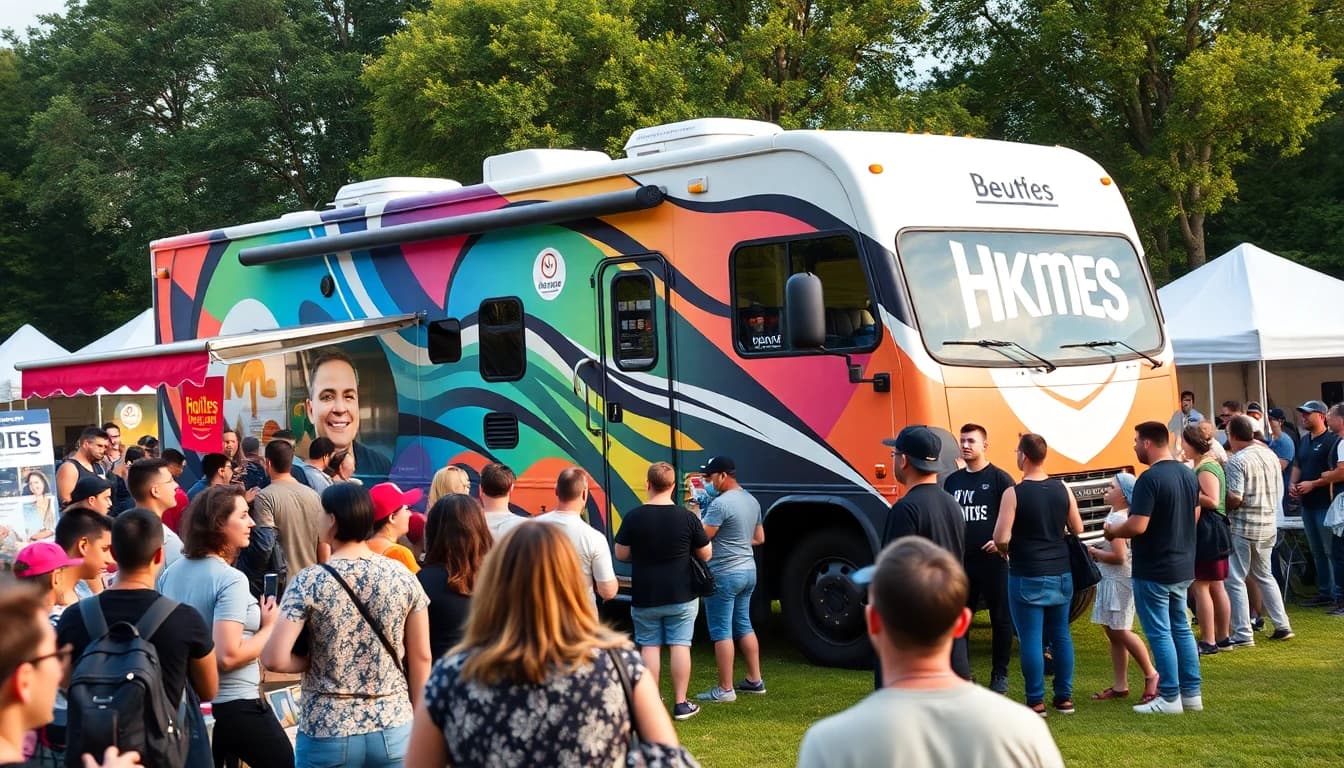
Planning a tour or activation?
Send the route, the venues and what the build needs to do. We will tell you which licence class, which venue credentials and which permits it lands in before anything gets wrapped.
Experiential briefs describe the experience: the wrap, the build, the demo, the queue. Every hard constraint on an activation comes from somewhere else entirely, and there are three of them. Federal motor carrier rules govern the vehicle. The venue governs the credential. And if any part of it goes indoors, fire code governs the display.
| Threshold | Rule | What crossing it means |
|---|---|---|
| 10,001 lbs GVWR | 49 CFR 390.5 | The vehicle is a commercial motor vehicle when used on a highway in interstate commerce to transport passengers or property. Every motorhome in our spec table exceeds this. |
| More than 8 passengers including the driver, for compensation | 49 CFR 390.5 | Commercial motor vehicle status on passenger count alone, well below the CDL line. |
| 16 or more passengers including the driver | 49 CFR 383.91 Group C | A CDL is required regardless of weight. The same figure SoFi uses to classify a vehicle as oversized. |
| 26,001 lbs GVWR or GCWR | 49 CFR 383.91 Groups A and B | A CDL is required on weight. Group A also requires the towed unit to exceed 10,000 lbs GVWR. |
The first threshold is much lower than the one everyone asks about
Every activation conversation eventually reaches "do we need a CDL driver?", which is answered at 26,001 pounds. The question that comes first is answered at 10,001.
49 CFR 390.5 defines a commercial motor vehicle as one "used on a highway in interstate commerce to transport passengers or property" with a gross vehicle weight rating of 10,001 pounds or more. Every unit in our published spec table clears that easily: Winnebago Minnie Winnie at 14,500 lbs, Winnebago Adventurer 35F at 22,000 lbs, Winnebago Adventurer 36Z at 24,000 lbs.
And "interstate" is broader than crossing a state line
49 CFR 390.5 includes transportation "Between two places in a State as part of trade, traffic, or transportation originating or terminating outside the State." A tour leg that stays inside one state is not automatically intrastate if it is part of a longer route that began elsewhere. For a multi-market activation tour, that is the normal case rather than the exception.
Then the venue applies its own definition, and they disagree
Federal status settles what the vehicle is. It settles nothing about whether it can arrive. Each venue defines an oversized vehicle on its own axis, and a unit credentialed at one is refused at another.
| Venue | Decides on | Without the credential |
|---|---|---|
| SoFi Stadium | Vehicle type and seat count | "Vehicles without proper credentials will be redirected off-site." |
| Churchill Downs | Named vehicle category | "Incorrect vehicle types will be turned away." Also stated as "Wrong vehicle types will be denied entry." |
| Circuit of The Americas | What the site can hold | "Non-permitted vehicles are subject to be towed away at the owner's expense." Box trucks, cargo trucks, rental trucks, enclosed hauling trucks and tractor-trailer rigs are not allowed at all. |
| GEHA Field at Arrowhead Stadium | Length, with a hard ceiling | Over 40 feet, no credential exists. The vehicle cannot enter the complex. |
| Lambeau Field | Whether it fits a standard stall | No venue credential exists for an RV. The arrangement is with a separate company entirely. |
For a touring activation this compounds. A single vehicle visiting six venues faces six credentialing determinations, and the one that stops the tour is whichever venue has the tightest rule. Arrowhead publishes a hard ceiling at 40 feet with nothing available above it; Lambeau requires a 9 by 18 foot stall, which excludes RVs from its lots entirely.
Spec the tour to the tightest venue, not the first
A build sized for the flagship market and then routed through a venue with a length ceiling has to be re-specced or that market gets dropped. Collect every venue's definition before the vehicle is chosen, and let the most restrictive one set the envelope. It is a week of emails and it is the difference between a tour and a tour with a hole in it.
Indoors, fire code takes over
If the vehicle goes inside an exhibit hall, the governing rules change entirely. Clark County Fire Code section 314.4, covering indoor displays, requires that "Fuel in fuel tanks does not exceed one-quarter tank or 5 gallons (19 L) (whichever is least)," that "Batteries are disconnected, or the engine starting system is made inoperable, except where the fire code official requires that the batteries remain connected to maintain safety features," and that vehicles "are not fueled or defueled within the building."
For a large vehicle the quarter-tank figure never binds, because five gallons is always the lesser number. And since you cannot defuel inside, the tank has to be brought down to compliance somewhere else during move-in, on your schedule.
The battery rule matters more for an activation than for a static display, because activations are full of things that need power: screens, lighting, compressors, sampling equipment. With the starting system disabled, none of it runs off the vehicle. Everything comes from venue electrical service, ordered on the show's deadlines at the show's advance rate. Our trade show guide covers that in full.
On the street, it becomes a permit
Street-level activations are a fourth situation with a fourth rulebook, and it is municipal. In the City of Los Angeles, FilmLA states that posted no-parking signs are "intended for production vehicles with commercial license plates only," that "Cast and crew vehicles may not park on public streets," and prices curbside space at $69 per 300 linear feet.
We are not going to extrapolate Los Angeles pricing to your market. What travels is the shape: a branded vehicle on a public street is a permitted object, the permit will have a plating requirement, an hours window, a notice period and a footage-based cost. Ask your local film office or special events office those four questions.
What most people get wrong: the wrap is not the long lead item
Activation timelines are built around the creative: design, approval, print, wrap, build. Those are real and they are also the parts your agency controls.
The items you do not control are the venue credentials, which may not go on sale until the event does, the permits, which have notice periods attached, and the electrical service orders, which have advance-rate deadlines. Those are the ones that fail quietly, because nobody is chasing them the way they chase artwork.
An earlier version of this page carried eleven cost ranges for activation vehicles. None was sourced, and in a category where the venue and permit lines are genuinely unpublished, a tidy all-in figure is the least useful thing we could give you. What we can give you is the list of lines and who to get each one from.
"Agencies come to me with a beautiful deck and a vehicle already chosen, and my first three questions are boring: what does it weigh, how many seats, and which venues. Because the weight decides the federal position, the seats decide the licence, and the venues decide whether it can turn up at all. I would much rather have that conversation before somebody has paid for a wrap."
— Ben Kiser, Co-Founder, EventFleetRV
Plan it in this order
- List every venue on the route and collect each one's oversized vehicle definition in writing.
- Let the most restrictive venue set the vehicle envelope, before anything is specced or wrapped.
- Check the GVWR against 10,001 lbs and the seat count against 8 and 16, separately from the CDL question.
- Establish whether the movement is interstate commerce as 390.5 defines it, including the two-places-in-one-state case.
- If any leg goes indoors, plan the fuel state as a load-in task and order venue electrical service early.
- For street activations, ask the local authority about plating, hours, notice period and footage cost.
- Fix the unit cost, and carry credentials, permits and electrical as named open lines.
Frequently Asked Questions
Is a mobile marketing vehicle a commercial motor vehicle?
Very likely. 49 CFR 390.5 defines a commercial motor vehicle as one "used on a highway in interstate commerce to transport passengers or property" with, among other triggers, a gross vehicle weight rating of 10,001 pounds or more. Published specs put a Class C motorhome at 14,500 lbs and Class A units above 22,000, all well over that line. An activation tour moving branded equipment between states is squarely the fact pattern the definition describes.
Does a branded activation vehicle need a CDL driver?
Not automatically, and that is the trap. 49 CFR 383.91 sets the CDL weight line at 26,001 pounds, far above the 10,001 pound commercial motor vehicle line. A vehicle can sit inside the federal motor carrier framework without needing a CDL to drive, so "we do not need a CDL" answers the licensing question and says nothing about the first one.
What are the rules for taking an activation vehicle inside an exhibit hall?
Fire code, not venue policy. Clark County Fire Code section 314.4, governing indoor displays, requires that "Fuel in fuel tanks does not exceed one-quarter tank or 5 gallons (19 L) (whichever is least)," that "Batteries are disconnected, or the engine starting system is made inoperable," and that vehicles "are not fueled or defueled within the building." Anything the display needs to do on the floor runs on venue-supplied electrical service.
Can you park an activation vehicle on a public street?
Only under a permit, and the plating matters. In the City of Los Angeles, FilmLA states posted no-parking signs are "intended for production vehicles with commercial license plates only," and that "Cast and crew vehicles may not park on public streets." Curbside space is sold at $69 per 300 linear feet. Other jurisdictions permit differently, so ask your local film office or special events office the same questions.
How much does a brand activation RV cost?
There is no published rate card for this, and an activation budget is mostly lines nobody publishes: venue credentials, permits, electrical service, wrap and build, and a driver whose licence class depends on the vehicle. What can be quoted firmly is the unit for stated dates. Fix that, establish the licence class and the venue credential, and hold the rest as named open lines.
Sources
- 49 CFR § 390.5 — Definitions — the commercial motor vehicle definition, the 10,001 lb and 8 / 15 passenger thresholds, and the definition of interstate commerce. Checked September 7, 2026.
- 49 CFR § 383.91 — Commercial motor vehicle groups — the 26,001 lb CDL threshold and the 16-passenger Group C threshold. Checked September 7, 2026.
- Clark County Fire Code 2018, section 314.4 — the indoor display fuel limit, battery disconnection requirement and the prohibition on fueling within the building. Checked September 7, 2026.
- FilmLA — Area Requirements: City of Los Angeles — the commercial license plate condition, the prohibition on cast and crew vehicles on public streets, and the $69 per 300 feet posted no-parking fee. Los Angeles only. Checked September 8, 2026.
- Venue credential rows are transcribed from each venue's own parking pages; see the linked venue in the table above.
Related Guides
Ben co-founded EventFleetRV and oversees all fleet operations and logistics. With extensive experience coordinating RV deployments for NASCAR events, major festivals, and corporate productions, he ensures every fleet delivery exceeds client expectations.
Specced to the Tightest Venue on the Route
Send us the markets and we will tell you what can legally arrive at all of them before the wrap is designed. One request, one contact, one invoice.