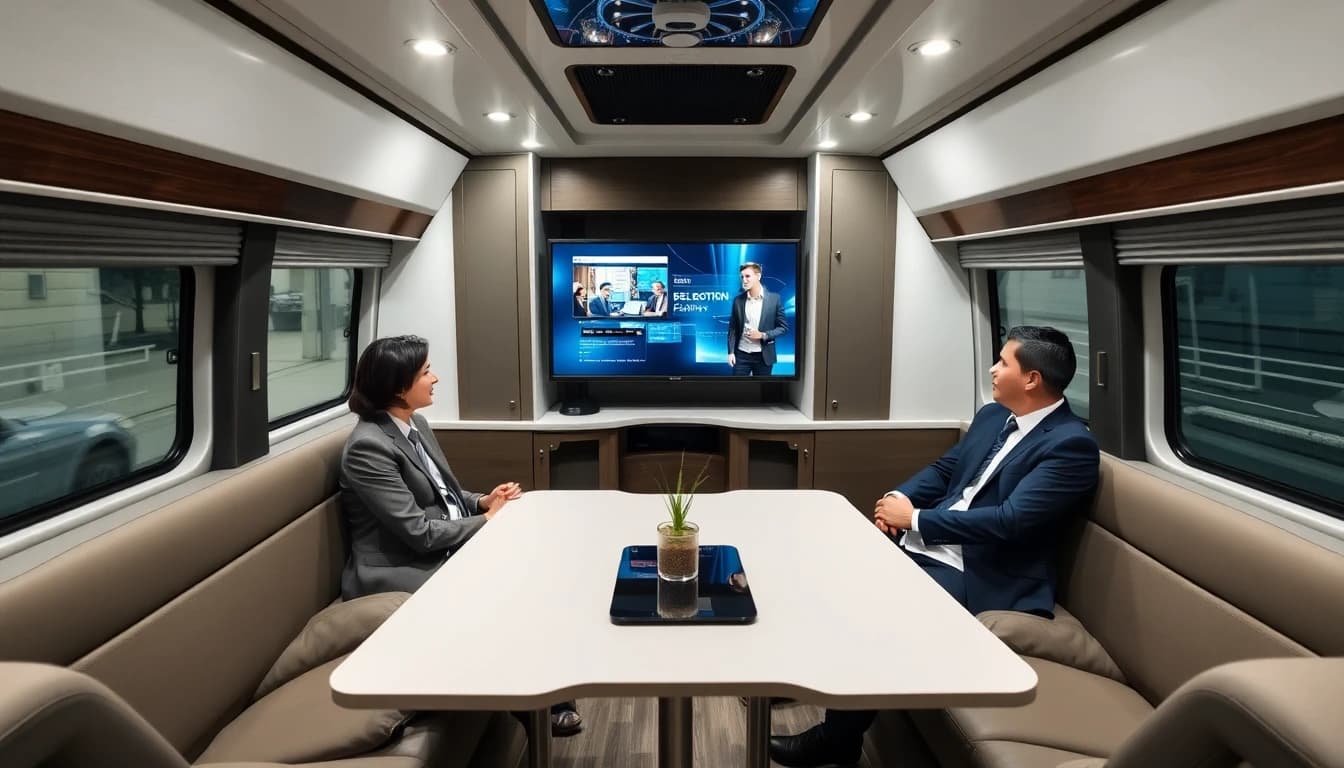
Need private meeting space on site?
Tell us where the unit needs to sit: inside a hall, in a venue lot, or on your own property. Each answer has a different rulebook and we will work to the right one.
A mobile meeting room is a straightforward product: a private, climate-controlled space with a table, power and a washroom, that arrives on wheels. Everything difficult about deploying one comes from a single question nobody asks first. Where exactly is it going to sit?
| Where it sits | Governed by | The binding constraints | Power |
|---|---|---|---|
| Inside an exhibit hall | Fire code (indoor display rules) | Fuel at a quarter tank or 5 gallons, whichever is least. Batteries disconnected. No fueling or defueling in the building. | Venue electrical service only, ordered to the show’s advance-rate deadline. |
| A venue lot or forecourt | The venue’s oversized vehicle policy | A credential defined by that venue. Without it, SoFi states vehicles "will be redirected off-site." | Onboard generator or a shore connection, venue permitting. |
| Private property | The property owner, plus any local rules | Access, turning circle, surface and overhead clearance are the real limits rather than a rulebook. | Onboard generator or a building tie-in. |
Indoors, the vehicle stops being a vehicle
Clark County Fire Code section 314.4, which governs vehicles displayed indoors, imposes three requirements that between them take away everything a meeting room would normally rely on.
"Fuel in fuel tanks does not exceed one-quarter tank or 5 gallons (19 L) (whichever is least)." "Batteries are disconnected, or the engine starting system is made inoperable." And "Vehicles, aircraft, boats or motorcraft equipment are not fueled or defueled within the building."
A meeting room with no power is a shed
With the battery disconnected, nothing in the unit runs off the vehicle: no lighting, no climate control, no screens, no connectivity. All of it becomes venue-supplied electrical service, which is a show order with an advance-rate deadline attached. Miss that deadline and you are paying floor rates or holding meetings in an unlit box. Order the power at the same moment you book the unit.
The fuel rule is a load-in task with a location attached, not something the driver handles at the door, because defueling inside is prohibited. For a large unit the five-gallon figure always governs, which is a very short range for getting the vehicle out again afterwards.
In a venue lot, it is a credentialing question
Outside the hall the fire code rules fall away and the venue's own oversized vehicle policy takes over. SoFi Stadium, as one published example, defines oversized vehicles as "Recreation Vehicles (RV's), Shuttles, Buses, Motorcoaches or any motor vehicle with a seating capacity of 16 or more people," and states that "Vehicles without proper credentials will be redirected off-site."
Every venue writes that definition differently, and a unit credentialed at one can be refused at another. Our comparison of five venues sets out how far apart they are: one decides on seat count, one on a length ceiling, one on whether the vehicle fits a standard parking stall.
On private property, the constraint is geometry
A corporate campus, a car park you control, a site compound. Here there is no rulebook to read, which people assume makes it simple. What replaces the rulebook is physical: whether the unit can reach the position at all.
The questions that actually decide it are the turning circle at the entrance, overhead clearance including any barrier or canopy, the surface and its load bearing, and whether the unit can be positioned without reversing blind. Those are answered by a site visit or good photographs, not by a specification sheet.
The barrier nobody measures
Height restriction barriers at car park entrances are the most common reason a unit cannot reach an otherwise perfect position on private property. They are easy to miss on a plan and impossible to solve on the day. Measure the lowest point on the route in, not just the destination.
If it is a workplace, the site has sanitation obligations
A meeting room with its own washroom serves the people inside it. It does not discharge a site's obligations to everyone working there, and that distinction catches people who deploy a unit to a working site and treat it as the sanitation provision.
On construction work, 29 CFR 1926.51 Table D-1 requires 1 toilet facility for 20 or fewer employees, and 2 toilet seats and 2 urinals (1 per 40 workers) at 80. The same standard requires that "An adequate supply of potable water shall be provided in all places of employment.", that portable containers be "capable of being tightly closed, and equipped with a tap", and that "The common drinking cup is prohibited."
Whether that standard governs your particular site is a question for your safety team. The point is that it is a site-level ratio against headcount, and a single meeting room does not satisfy it.
What most people get wrong: booking the room before choosing the spot
The usual sequence is to specify the interior, book the unit, then work out placement. Every constraint on this page arrives after that decision, which is why they arrive as problems.
Reversed, it is easy. Decide the exact position first. That single answer tells you which framework applies, whether the unit can use its own power, what credential you need, and what the real lead times are. The interior specification is the last decision, not the first, and it is the one with the fewest constraints on it.
An earlier version of this page carried eight cost ranges. None was sourced, and in a category where the venue credential and the electrical service are both unpublished, an all-in figure would be the least useful thing on the page.
"Every mobile meeting room enquiry starts with how many people round the table, and I always ask where it is parking. Inside a hall it is a fire code job with no battery and a power order. In a stadium lot it is a credential. On your own car park it is whether the height barrier lets it in. Same unit, three completely different jobs, and only one of them is about the table."
— Ben Kiser, Co-Founder, EventFleetRV
Plan it in this order
- Fix the exact position before anything else. Indoors, venue lot and private property are three different jobs.
- If indoors, plan the fuel state as a load-in task and assume the battery is disconnected.
- Order venue electrical service by the advance-rate deadline, for everything the room needs to do.
- If in a venue lot, get that venue's oversized vehicle definition and credential in writing.
- If on private property, measure the route in: turning circle, overhead clearance, surface, reversing.
- If the site is a workplace, confirm sanitation is being met at site level rather than by the unit.
- Specify the interior last, and quote the unit firmly with credentials and power as open lines.
Frequently Asked Questions
Can a mobile meeting room run off its own power inside a venue?
Not inside an exhibit hall. Clark County Fire Code section 314.4 requires that "Batteries are disconnected, or the engine starting system is made inoperable, except where the fire code official requires that the batteries remain connected to maintain safety features." So screens, lighting, climate control and connectivity all run on venue-supplied electrical service, ordered through the show on its deadlines.
How much fuel can a vehicle have inside an exhibit hall?
Under Clark County Fire Code 314.4, "Fuel in fuel tanks does not exceed one-quarter tank or 5 gallons (19 L) (whichever is least)." For a large vehicle the quarter-tank figure never binds because five gallons is always the lesser number. The same section states that vehicles "are not fueled or defueled within the building," so the tank has to be brought down to compliance before the unit enters.
What do you need to bring a mobile meeting room to a stadium or arena?
An oversized vehicle credential, defined by that venue. SoFi Stadium, for example, classifies "Recreation Vehicles (RV's), Shuttles, Buses, Motorcoaches or any motor vehicle with a seating capacity of 16 or more people" as oversized and states that "Vehicles without proper credentials will be redirected off-site." Every venue defines this differently, so get the specific definition in writing.
Do you need to provide toilets and water for people using a mobile meeting room?
If it is a workplace, sanitation standards apply to the site rather than to the vehicle. On construction sites 29 CFR 1926.51 Table D-1 requires 1 toilet facility for 20 or fewer employees and 1 toilet seat and 1 urinal per 40 workers above that, alongside a requirement that "An adequate supply of potable water shall be provided in all places of employment." A meeting room with its own washroom serves the people in it, not the headcount on the site.
How much does a mobile meeting room cost to rent?
The unit can be quoted firmly for stated dates. What cannot be fixed in advance are the venue credential, which most venues do not price publicly, and electrical service, which is a show order with an advance-rate deadline. Build the budget as one firm number and a set of named open lines rather than a single all-in figure.
Sources
- Clark County Fire Code 2018, section 314.4 — the indoor display fuel limit, the battery disconnection requirement and the prohibition on fueling or defueling within the building. Checked September 7, 2026.
- SoFi Stadium — Parking — the oversized vehicle definition and the redirect-off-site rule, as one published example of a venue credential. Checked September 7, 2026.
- 29 CFR § 1926.51 — Sanitation — Table D-1 toilet ratios and the potable water requirements. Checked September 8, 2026.
- 49 CFR § 390.5 — Definitions — commercial motor vehicle thresholds relevant to moving the unit between sites. Checked September 7, 2026.
Related Guides
Ben co-founded EventFleetRV and oversees all fleet operations and logistics. With extensive experience coordinating RV deployments for NASCAR events, major festivals, and corporate productions, he ensures every fleet delivery exceeds client expectations.
Tell Us Where It Parks
That one answer decides the rulebook, the power and the lead times. We will work to the right one. One request, one contact, one invoice.