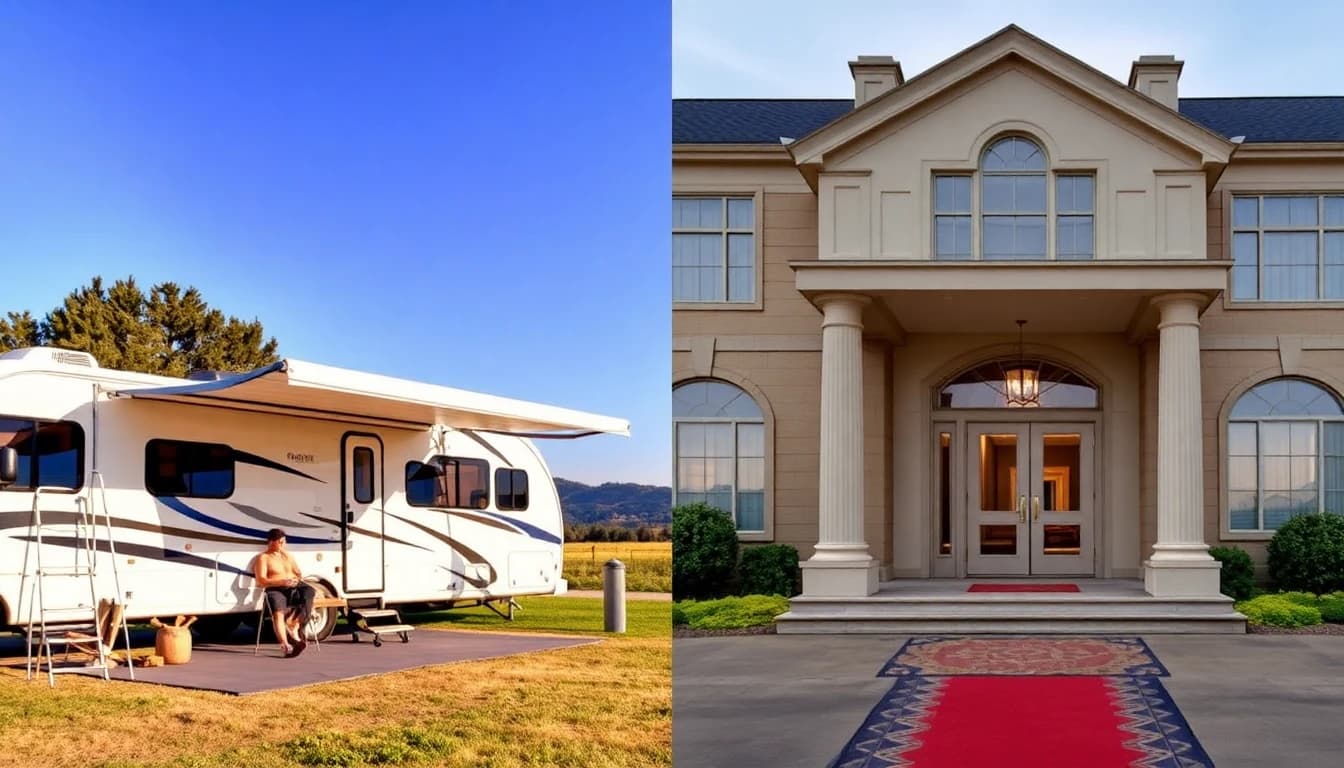
Weighing RV against hotel for an event?
Tell us the venue and we will tell you first whether an RV is permitted there at all, and on what terms. That answer usually settles it.
Why this page has no per-night comparison
An earlier version claimed RV camping "often wins at $50-$100/person/night vs hotels at $150+". Neither figure was sourced, and the deeper problem is that most venues do not publish a camping or parking rate at all, so there is nothing on one side of that comparison to compare with.
What venues do publish is whether an RV is permitted, when it may arrive, whether it may stay overnight, and what waste service costs. Those decide the question far more often than price does.
Check availability before affordability
Across the venues researched for this site, a striking number remove one of the two options entirely.
Coachella states "NO RV/Motorhome camping. Passenger cars, trucks or vans only." Lambeau Field requires that vehicles in any stadium lot "must fit in a 9x18 parking stall," which no motorhome does. Arrowhead states that "Vehicles longer than 40 feet... are not permitted inside the Truman Sports Complex." At each of those, a cost comparison is moot for at least some units.
One question, asked first, saves the whole exercise
Before pricing anything, read the venue's own camping or parking page and establish whether an RV of your size is permitted. It takes ten minutes and it settles a meaningful share of these decisions outright. Everything below only matters once the answer is yes.
The comparison that actually decides it
| Factor | RV | Hotel |
|---|---|---|
| Can you even do it? | Venue-dependent. Coachella states "NO RV/Motorhome camping." Lambeau requires vehicles fit a 9x18 stall. Some venues have no RV product at all. | Always available in principle, subject to rooms existing. |
| Arrival window | Often fixed and narrow. Highmark Stadium admits RVs only the day before, 8:00 AM to 10:00 PM, with no game-day entry. | Standard check-in, and late arrival is normal. |
| Overnight | Not guaranteed. SoFi states any vehicle left overnight "will be towed at the owner's expense." | The entire product. |
| Waste | A recurring paid service almost everywhere. Bonnaroo: "There will not be any hookups or dumping areas," with mobile pump service at $75 per service. | Not your problem. |
| Power | Varies by area within a single venue. Daytona lists power in three of eight RV areas. | Included. |
| Getting to the event | Usually solved. On-site or adjacent camping means no daily commute. | A daily journey each way, at the times everyone else travels. |
| Group privacy and space | One space for the whole group, with a kitchen. | Separate rooms, shared public areas. |
The arrival window is the constraint nobody prices
A hotel absorbs a delayed flight. An RV booking often cannot. Highmark Stadium admits RVs only from "8:00 AM (1) day prior" to "10:00 PM (1) day prior," with no day-of-game entry permitted at all.
That is a fourteen-hour window, once, the day before. It changes the rental length, it changes who can travel when, and it can rule the option out for anyone who cannot leave work on the Friday. None of that appears in a nightly-rate comparison.
SoFi Stadium is the mirror image: "Any vehicles left overnight will be towed at the owner's expense," so the coach cannot be accommodation there at all. Two venues, opposite rules, and at both the decision is made before cost.
Two costs an RV carries that a hotel does not
Waste service. Almost no venue we have checked provides a sewer connection. Bonnaroo states plainly "There will not be any hookups or dumping areas" and runs a mobile pump service at "$75 per service." No Daytona campground publishes a sewer hookup. That is a recurring line driven by headcount and nights, and it has no hotel equivalent.
Fuel, both ways. At the EIA's the week ending August 31, 2026 on-highway diesel average of $5.60 per gallon, a unit returning 8 mpg costs roughly $0.70 per mile. A delivery is a round trip whether or not the coach comes back with you, so a 200-mile job is 400 miles of fuel.
And one cost a hotel carries that an RV does not
The commute. At a large event that is not just a fare, it is the hours at the start and end of every day when a hundred thousand people move at once. An RV positioned on or beside the site removes it entirely, and for multi-day events that is usually the honest reason people choose one, rather than the arithmetic.
Where power decides it outright
Hotels include power. RVs do not necessarily, and the variation is inside a single venue rather than between venues. Daytona lists power in three of its eight RV areas, and which one you are assigned is often decided by a waitlist rather than by you.
If anyone in the party depends on powered equipment overnight, that uncertainty is the deciding factor. It is not a comfort trade, it is a reliability one, and a hotel room is the option that guarantees the outcome.
What most people get wrong: treating it as one decision for the whole group
The framing assumes everyone travels the same way. Most groups do not. Some can arrive the day before and some cannot. Some need guaranteed power and most do not.
Solving those separately is usually cheaper and always less stressful than forcing one option to cover everyone: an RV where it is permitted, for the people whose travel fits, and rooms for the ones whose does not. That is not a compromise, it is matching each constraint to the thing that actually handles it.
"People ring me having already done a spreadsheet, and the first thing I usually have to tell them is that the venue does not allow what they have costed. Coachella will not have a motorhome on site. Buffalo will not let one in on game day. Once that is settled the money question is usually easy, and honestly the thing that sells it is never the price, it is not sitting in traffic for two hours at midnight."
— Ben Kiser, Co-Founder, EventFleetRV
Decide in this order
- Read the venue's own page and establish whether an RV of your size is permitted at all.
- Find the arrival window and check it against how your group can actually travel.
- Check whether overnight presence is permitted. At some venues it is not.
- Establish whether the area has power, and whether anyone in the party depends on it.
- Add waste service as a recurring cost against headcount and nights.
- Calculate fuel from the current EIA price against round-trip mileage.
- Consider splitting the group rather than forcing one option to cover every constraint.
Frequently Asked Questions
Is RV camping cheaper than a hotel for an event?
It can be, but the comparison is rarely reached, because at many venues one of the two options does not exist. Coachella states "NO RV/Motorhome camping." Lambeau Field requires that vehicles "must fit in a 9x18 parking stall," which excludes RVs from its lots. Establish whether the venue permits an RV at all before pricing anything, and note that most venues do not publish a camping or parking rate to compare against.
What costs does an RV have that a hotel does not?
Waste service and fuel are the two that get missed. Bonnaroo states "There will not be any hookups or dumping areas" and runs a mobile pump service at $75 per service; no Daytona campground publishes a sewer hookup. On fuel, at the EIA's the week ending August 31, 2026 on-highway diesel average of $5.60 per gallon, a unit returning 8 mpg costs about $0.70 a mile, and a delivery is a round trip.
What does an RV give you that a hotel cannot?
Position and the absence of a commute. On-site or adjacent camping removes the daily journey at exactly the hours when everyone else is travelling, which at a large event is the single largest quality-of-life difference. It also gives a group one private space with a kitchen rather than separate rooms and shared public areas.
When is a hotel clearly the better choice?
When the venue does not permit an RV, when the arrival window does not fit your travel, or when someone in the party needs reliable overnight power. SoFi Stadium prohibits overnight vehicles entirely, and Highmark Stadium permits no day-of-game RV entry, so at those venues the practical answer is decided before any cost comparison begins.
Can you combine both?
Frequently that is the right answer. An RV placed where it is permitted, with hotel rooms for anyone whose travel does not fit the arrival window or who needs reliable power overnight, solves the constraints separately rather than forcing one option to cover everything.
Sources
- Coachella — Camping — the prohibition on RV and motorhome camping. Checked September 7, 2026.
- Buffalo Bills — Stadium Parking — the day-before-only RV entry window and the absence of day-of-game entry. Checked September 7, 2026.
- SoFi Stadium — Parking — the prohibition on overnight vehicles and the towing rule. Checked September 7, 2026.
- Bonnaroo — Water hookups, sewage and dumping — the absence of hookups or dumping areas and the $75 mobile pump service. Checked September 7, 2026.
- Daytona International Speedway — Speedweeks Camping — campground list used for the power availability comparison. Checked September 7, 2026.
- U.S. Energy Information Administration — Gasoline and Diesel Fuel Update — the on-highway diesel average used in the per-mile arithmetic. These are weekly national averages and move; re-check before relying on them.
Related Guides
Ben co-founded EventFleetRV and oversees all fleet operations and logistics. With extensive experience coordinating RV deployments for NASCAR events, major festivals, and corporate productions, he ensures every fleet delivery exceeds client expectations.
We Will Tell You If It Is Not Allowed
Send us the venue and we will check the rules before we quote. Sometimes the honest answer is a hotel, and we would rather say so.